
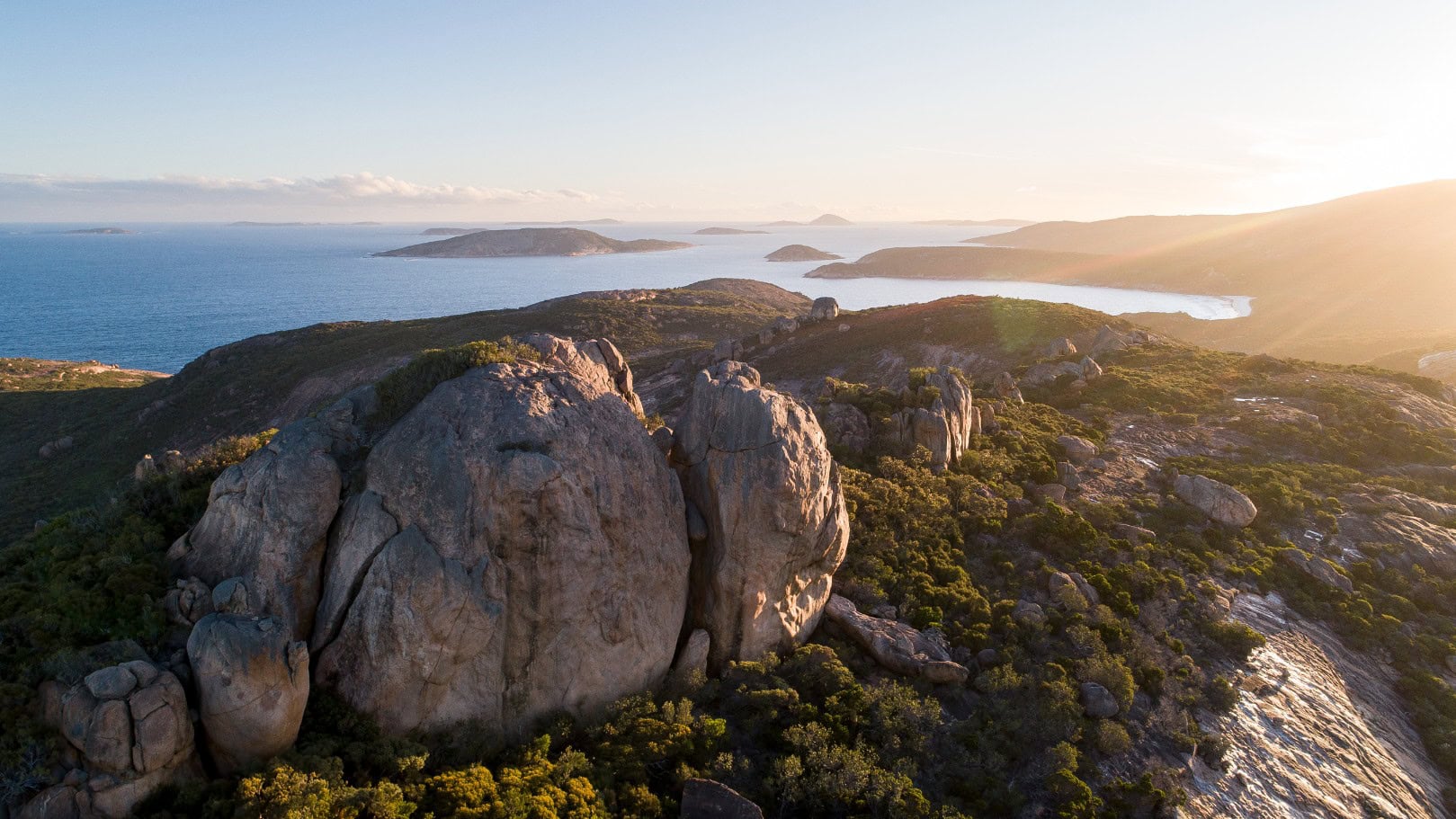
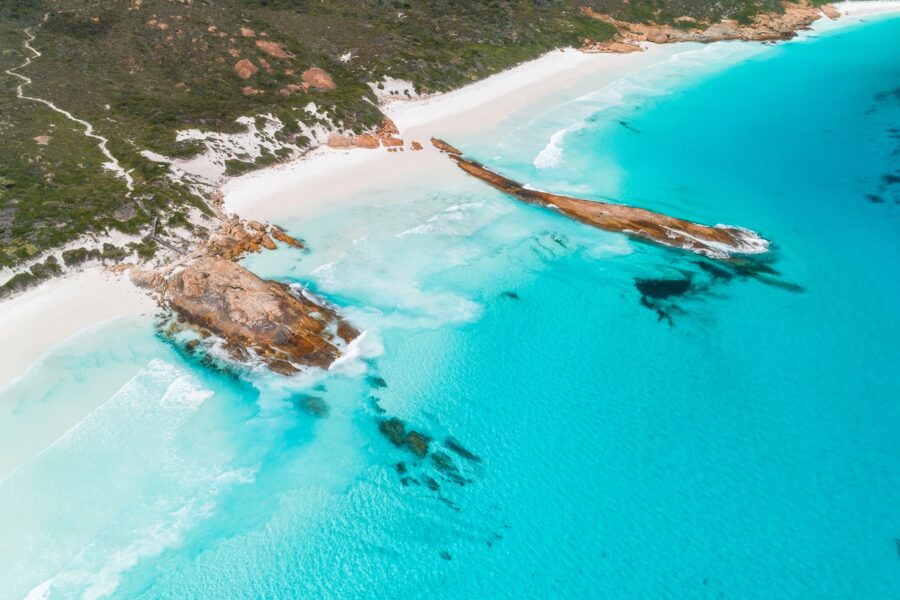
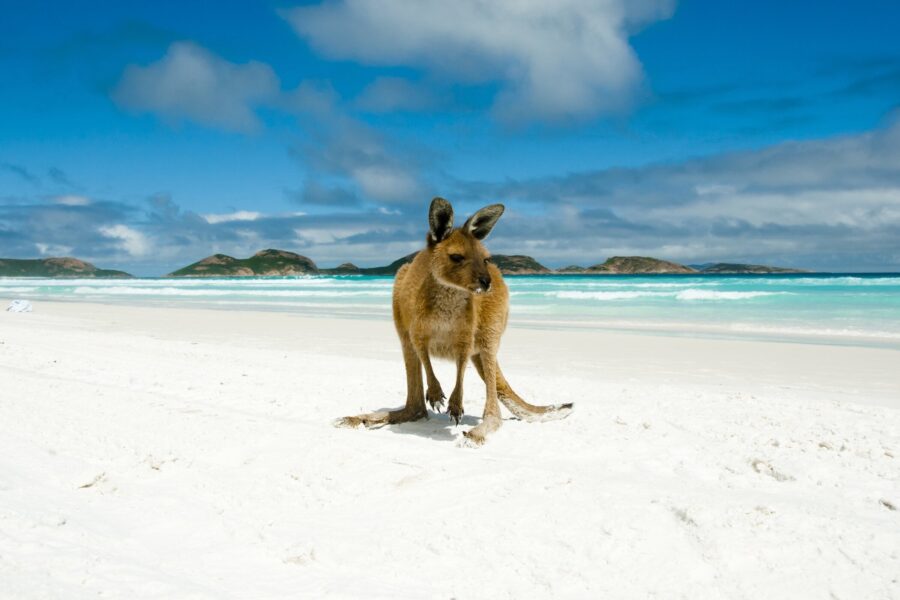
Seas of turquoise and ice blue water, islands in the distance; surfers riding lazy waves and kangaroos reclining on whiter than white beaches. Lucky Bay, Cape le Grand, Pink Lake, the Great Ocean Drive, Wharton’s Beach.
Named and unnamed wonders that make the coastal town of Esperance a focal point for interactions with the natural world; the beaches and bushland that make southern Western Australia so unique. But Esperance is about so much more. It is the hidden extras, experiences that will make your adventure truly worthwhile, that you should take the time to include in your plans.
[Check Google Doc for internal Page Links]
Beaches and the coast
Encompassing over 400km of coastline, with access to more than 100 beaches, Esperance is spoilt for choice when it comes to interacting with the natural world. The coastline is not just lengthy: it is diverse. Gentle waters lap the shores in sheltered bays; views are framed by the picturesque islands of the Recherché Archipelago, and spectacular cliffs tower over whales in waters of the Great Australian Bight.
It is not necessary to visit all to savour the ocean and its pleasures. Close to Esperance are some remarkable and accessible beaches.
[insert POI list module when ready]
Cape le Grand National Park
Cape le Grand National Park is a jewel in Western Australia’s treasure trove of wild places. But it is not so isolated that its natural assets cannot be readily enjoyed (if you have access to a vehicle to navigate the 60km drive east of town). Within this national park are some of the finest beaches in the region: Lucky Bay (where kangaroos regularly laze on the sands), Hellfire Bay, Thistle Cove, Le Grand Beach and Rossiter’s Bay. All make a journey to this place worthwhile. Swimming, snorkelling, surfing, fishing and reading on the beach are activities that can be enjoyed within its boundaries.
Hiking allows for land based engagement with the natural world, with the view from Frenchman Peak making the challenging 3km climb up its slope worthwhile (allow at least 1.5 hours). The Cape le Grand Coastal Trail (15km) can be tackled in sections, with each portion of the walk providing breathtaking views of the landscape. Because this is a national park, a Park Pass is required to enable entry.
Internal link: anchor "Cape Le Grand National Park" → /cape-le-grand-national-park not yet!
The Great Ocean Drive
From Twilight Beach Road to Pink Lake Road via 11 Mile Beach Road, or vice versa. The Great Ocean Drive provides visitors to Esperance with a literally breathtaking introduction to its natural coastal wonders. The 40-kilometre sealed road loops from one part of the town back to another, allowing drivers to enjoy the essence of Esperance.
As the road twists and turns along the coast, each summit provides a different view of stunning beaches, dramatic rocky headlands, small bays, steep cliffs and hidden ocean pools.
Done on arrival, this drive sets the tone for your visit; done in the late afternoon, it provides spectacular sunsets! (Best not to be driving into the sun though, it is blindingly brilliant as it goes down! Park up in time to enjoy the glow!) Allow 1.5 to 2 hours to enjoy the drive and allow for pauses along the way.
While the drive alone is worthwhile, and the perfect way to enter the town and get a feel for the place, it is much more than a coastal drive. There are opportunities to stop at several beaches, and slip into the sea to enjoy snorkelling, surfing and swimming. A cycleway allows for bike riding, and coastal trails encourage bush walking.
The Cannery Art Centre, Rotary Lookout (Wireless Hill), and Pink Lake Lookouts provide opportunities for whales watching (in season) and are vantage points from which views can be absorbed. But they are not the only lookouts along the route, with expansive views to be enjoyed from several sites including Lover’s Cove, West Beach, Chapman’s Point, the Salmon Beach Wind Farm, Salmon Beach, Twilight Cove, Observatory Point and 10 Mile Lagoon.
There is no charge to access this scenic drive, and no bookings required and no fees for the natural attractions accessed along with way. The road is suitable for all vehicles. But cars are not essential: the Great Ocean Drive can be enjoyed by bicycle or on foot, with a cycle/walk path that follows the coast from the Esplanade to Twilight Cove, cuts through bushland up to Pink Lake, and back into town along Pink Lake Road.
https://www.visitesperance.com/experiences/attractions/great-ocean-drive ( inserted in first para
Wildlife and Nature
Unexpected and unplanned encounters with wildlife are joys Esperance has to offer. It is a paradise for serious naturalists, and people who just enjoy being part of the natural world. While we may see the kangaroos at Lucky Bay, and dolphins in the waters of West Beach, all year around there are some animals (like whales!) only seen during seasons.
[Whale Section]
Humpback and southern right whales make their annual migration between May to December travelling from the south-west to the Kimberley. Whale watchers in Esperance say that the best months to spot these magnificent marine mammals are from June to November, and that though you may be lucky enough to see them from the shore, the best way to see them is to book a tour and see them from the sea (or the air!) This is something that the staff at the Esperance Visitor Centre can help you with.
Find out more from the Department of Biodiversity, Conservation and Attractions about watching whales, the best times to see them, their behaviour and whale watching tips. To help protect yourself and the whales follow the Whale Watching Guidelines.
[Eagle Section]
White-breasted sea eagles soar over the coast line and are often seen within the boundaries of Cape le Grand National Park, while a boat trip to Woody Island, which is an A-class Reserve, will enable you to see sealions and seals stretched out as they rest on Seal Rock and other islands of the Recherche Archipelago.
And a walk or a paddleby canoe in the wetlands of Woody Lake and Lake Wheatfield will introduce you to some of the inhabitants of the Ramsar listed Lake Warden wetland system, such as black swans, egrets, pelicans and ducks.
[General Info]
There are so many fascinating plants and animals in the Esperance area, and beyond. Information on wildlife and nature in the region is available from the Esperance Visitor Centre, in the Market Village, and the Department of Biodiversity, Conservation and Attractions office on Dempster Street. A visit to the online resource, iNaturalist, will give you an insight into the range of plants and animals at home in this region.
[Parrot Section]
The remote and rugged Cape Arid National Park (147km east of Esperance: 4WD country) is the home of some of the last surviving Kyloring/Western Ground Parrots in Australia.
[Wildflower Section]
Wildflowers are synonymous with spring in the region, with two events celebrating the wide variety of species responsible for bringing colour to the bush. The Djilba (Esperance) Wildflower Festival and Ravensthorpe Wildflower Show and Spring Festival showcase the floral bounty found in the region. Please remember that wildflowers are protected, so resist the urge to pick them. (You need a permit to do so. Any unlawful taking of wildflowers from a national park or reserve can result in heavy fines by local rangers.) Best to take only pictures - and leave only footprints.
And look after yourselves: when searching for wildflowers, it is a good idea to wear insect repellent as where there are plenty of flowers, there are sure to be insects (think bees and honey!) Also, if you wear sunscreen, a hat and long-sleeved clothing, you will avoid sunburn.
[Parks & Trails]
There are several national parks in the region that allow people to access the wonders of nature, Cape Le Grand National Park, Cape Arid National Park, Stokes National Park and the Peak Charles National Park. On the way either to and from Esperance, there is the Fitzgerald River National Park (200km west of Esperance). Be mindful that entry and camping fees apply. Check road conditions before heading out by visiting the website https://alerts.dbca.wa.gov.au/ or contacting the Department of Biodiversity, Conservation and Attractions (DBCA), Esperance office on: (08) 9083 2100. If you plan on camping at one of these National Parks, here is some helpful information.
insert https://www.visitesperance.com/about-esperance/camping-in-the-shire-of-esperance in sentence above
There are also a number of trails and reserves that will allow you to mingle with plants and animals as you take a walk on Esperance’s wild side.
insert above https://www.visitesperance.com/experiences/activities/trailsandwalkways
Local Life
While nature dominates and locals value the nature of their place, Esperance town has more to offer. It may not be bursting with nightlife and a clubbing culture, but sport and the arts combine to keep the place buzzing. Locals gather to watch football matches on the weekend, there is horse racing during the season over summer, and there is always a performing arts event or exhibition to add interest to a holiday experience.
Time can be effortlessly whiled away at the Esperance Museum, where displays include information about the region’s past, including time before European settlement, its maritime history, displays of vehicles and machinery, the Sanko Harvest shipwreck, the crashing to earth of Skylab.
Then there is the Cannery Arts Centre, which hosts exhibitions of works created by artists, local and non-local, workshops and other cultural events like Balmy Nights.
And no visit to Esperance is complete without a walk on the Esperance Jetty, a place frequented by locals and visitors keen to drop in a line in the hope they may catch some herring or squid for a fresh taste of the ocean, or simply to savour the experience of walking over water. Pelicans sometimes gather at the jetty to take advantage of the scraps made available when fishers clean their catch, so visitors might be able to view these amazing birds “up (relatively) close.”
For those that enjoy the hustle and bustle of people gathering to shop and socialise, there are two regular markets held in Esperance, the Esperance Growers Market (with the focus on sustainability, growing and making) and the Esperance Museum Village Markets (with a wide range of stallholders and products on offer). More information on the markets can be obtained from the Esperance Visitor Centre.
Then there is Mermaid Leather, where visitors can see fish skins being processed into leather; the Esperance Distillery, which produces a range of handcrafted gins, and Lucky Bay Brewing, where beer is produced from locally grown grains.
insert above https://www.visitesperance.com/mermaid-leather / https://www.visitesperance.com/esperance-distillery / https://www.visitesperance.com/lucky-bay-brewing
There is so much more to be heard, seen and felt: Esperance demands more than a short stay! More information on what is on offer can be obtained from the Esperance Visitor Centre.
Activities and Adventures
Esperance is a place of adventure and action. It is an inevitable part of having oceans that can be plunged into, waves that can be ridden, waters that can be sailed, trails that can be hiked and mounts that can be climbed.
Water based activities:
-
Snorkelling
Woody Island, Le Grand Beach, Lucky Bay, Hellfire Bay, 10 Mile Lagoon, Quagi Beach, Munglinup Beach
-
Diving
Woody Island, Esperance Jetty, Sanko Harvest wreck
-
Sailing
Esperance Bay
-
Cruising
Charter boats and Woody Island Eco-tours
-
Fishing
Beach fishing, offshore charters
-
Surfing
West Beach, Chapman’s Point…various options: depends on the weather and the wind!
-
Windsurfing
Observatory Point and Fourth Beach
-
Hang-gliding
Observatory Point
-
Swimming
So many options! Right in the middle of town, from Taylor Street to Castletown Quays and at Bandy Creek Boat Harbour there are places for little people to swim with their families.
Land based activities:
-
Hiking
Esperance has an excellent network of walk and trails, including the Great Ocean Pathway.
-
Cycling
Great Ocean Drive
-
4WD driving (off-road)
Cape Arid National Park, other National Parks and Esperance Shire Council reserves.
-
Camping
There are so many camping options, ranging from caravan parks, to National Parks, Shire managed campgrounds like Quagi Beach and Munglinup Beach…so many options!
Air based activities:
-
Scenic flights
Take to the air for a bird’s eye view of the Recherche Archipelago (HeliSpirit Esperance)
Seasonal Highlights
Esperance is a place renowned for its natural beauty, and like all things natural, the Esperance Experience changes with the seasons.
Summer (Dec-Feb) is the time to hit the beach! Immerse yourself in the ocean…and explore. Days are warm and long and typically clear. It can be windy, with south-easterly winds prevailing and cooling the evening air. The sea is sparkling blue, and beckoning, and the town is vibrant and bustling with holiday activity. This is the most popular time to visit Esperance, so if you want to camp at Lucky Bay, you will need to book well ahead.
Autumn (Mar-May) invites you outside, to explore the wild coastline, National Parks and beaches. Though this is considered a shoulder season, locals will tell you it is the best time to visit. Winds drop off and temperatures are comfortable. Days are generally clear. And there are fewer visitors. This period typically experiences northerly, or north-westerlies in the morning, tending to south-easterlies in the afternoon. But the winds are kinder than those of summer, and not usually as strong. Swells pick up through the autumn period and run through the winter months.
Winter (Jun-Aug) is a quieter time in Esperance (the colder weather tends to keep some visitors away), but it is the best time to visit if a) you don’t like the crowds, b) you like to spend your nights cosy by a fire, or c) you enjoy walking and connecting with native wildlife. Southern Right and Humpback Whales are in the waters from June to October and come right into the bays to calve. Sometimes they can be spotted from the shore, or from lookouts like that on Wireless Hill. Though there are days when dramatic storm fronts can be viewed from the same lookouts, there are many sunny blue sky days during Winter. The days may be colder, and there is a higher chance of rain, but with the right clothing, there are still adventures to be had. (And it is easier to find a campsite!)
Spring (Sep-Nov) is wildflower season. The bushland is ablaze with colour as native orchids, banksias, kangaroo paws and other plants flower outrageously, usually hitting their peak of showiness in October. Swells drop off, and the temperature warms up. There are still whales calving in the bays. This is considered by locals to be the second-best time to visit. Visitor numbers are still lower, so it is possible to feel the deliciousness of isolation. Spring wind patterns are like those of Autumn, with north westerlies common in the morning. Spring winds tend to pick up and change to southerlies or south-easterlies in the afternoons, but they are usually not as forceful of those in winter and summer.
FAQs
They are always in the park, but not always on the beach. The Lucky Bay kangaroos are Western Greys (Macropus fuliginosus), and like most kangaroos, they usually rest in the middle of the day and are active in the early morning and evening. These tend to be the best times of day to see them on the beach. Western grey kangaroos are primarily grazers, nibbling on native and introduced grasses. In forest and woodland habitats, they rely on browse from native shrubs.
Yes. It is a popular beach for swimming. Winds and weather can dictate which section of the 3km beach is best for a dip. Early morning on a calm day is usually pleasant, especially when a later northerly is in the offing. Not only are early morning swims less likely to be wind affected, but the beach is usually quieter at that time of the day. Note currents and rips and be aware of any risks to safety before taking the plunge.
Yes, it is in the Cape Le Grand National Park, east of Esperance. Cape le Grand is one of several national parks in the Esperance region. Large granite outcrops, white beaches, blue seas, wildflower dotted heathlands and dense thickets of showy banksia provide habitat for animals such as pygmy possums, kangaroos, and white bellied sea eagles. It is an ideal place for those who want to connect with nature, and enjoy swimming, surfing, fishing and boating in picturesque bays.
Yes, it is within the Cape Le Grand National Park so you will need to obtain a Park Pass, and if you want to camp, you will need to book a site as well. Entry fees for Cape le Grand National Park can be paid at the entry station on arrival at the park. Park passes can also be obtained online, and campsites can also be booked online, but be aware that in summer, they are hot property, in high demand and require booking well in advance.
Lucky Bay is about 63.6 km east of Esperance, allow for a drive of about 50 minutes. After heading east on Merivale Road, you will turn south on Cape le Grand Road, into the Cape le Grand National Park, and on to Lucky Bay.
It is a pleasant drive on a sealed road with views of rolling farmland. Lucky Bay is about 3.6km from the park entrance, via Lucky Bay Road, and the way is well signposted.
No. Dogs are not allowed in the Cape le Grand National Park. Dogs are excluded from visiting such places because they can injure or stress native animals. Even the smell of a dog can trigger fear in animals that view them as predators. But there is another reason for keeping your dogs out of such places. Sometimes, park managers use poison baits to control feral animals like foxes and cats, predators that are devastating native wildlife populations. These baits will kill domestic dogs. Nobody wants that! There are kennels in Esperance that can look after your furry friends while you explore (see links below).
Optional Tagline - Delete if not needed
Section Heading
Credit Photon Photos For those with adventure in their hearts and salt in their veins.Start ExploringPlan Your Trip Discover Esperance (Kepa Kurl) Four ways to…
Lorem ipsum dolor sit amet, consectetur adipiscing elit, sed do eiusmod tempor incididunt ut labore et dolore magna aliqua. Ut enim ad minim veniam, quis…
Lorem ipsum dolor sit amet, consectetur adipiscing elit, sed do eiusmod tempor incididunt ut labore et dolore magna aliqua. Ut enim ad minim veniam, quis…