
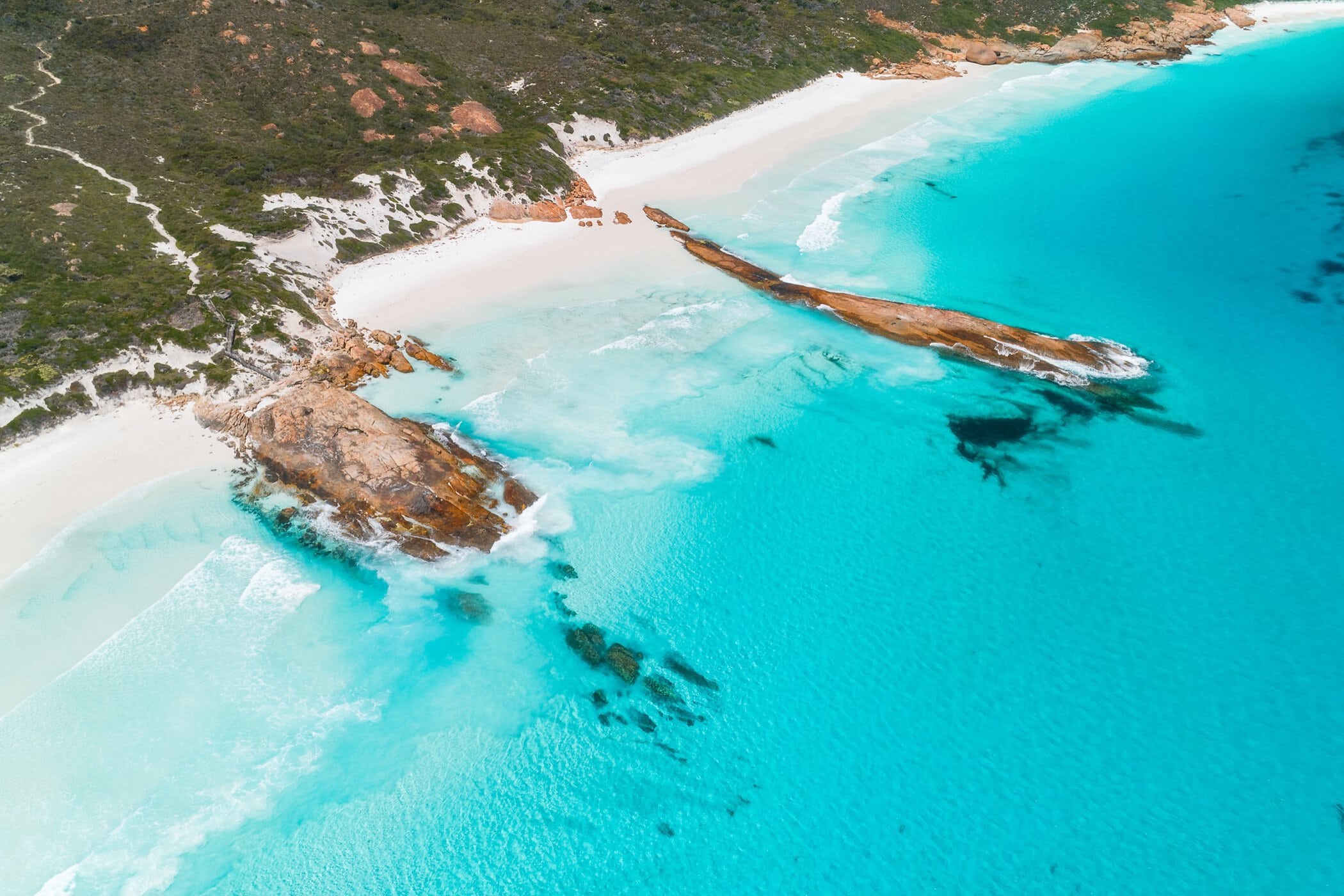
Located within the Cape le Grand National Park, this place was once a hidden gem. Esperance’s distance from Western Australia’s capital city and international airports meant few people other than locals knew of its virtues. But now the secret is well and truly out and those who make the distance, enjoy the rewards.
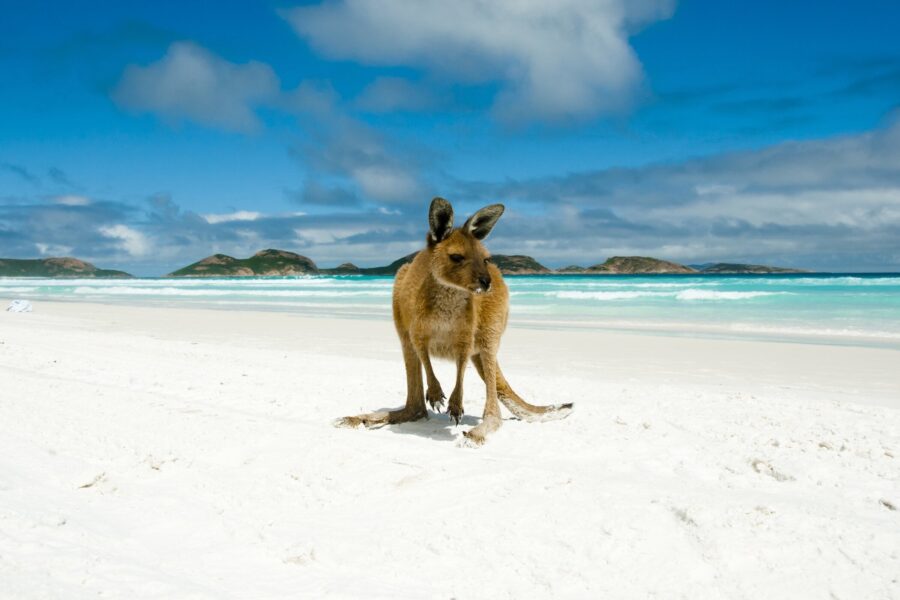
You have seen the iconic images of kangaroos lazing on the beaches. White sand. Turquoise water. A bay that sweeps away in a gentle arc. Images of Lucky Bay, synonymous with Esperance: in fact, that is probably what brought the coastal town to your attention in the first place. But is it really that good?
What makes Lucky Bay special?
Now you are here. Feeling the sand. Hearing the waves. Seeing it for yourself.
Sometimes, too much hype can lead to disappointment. What if there are no kangaroos on the beaches? What if the sky is overcast, the sea not turquoise but an unusually angry dark blue? And it rains.
It doesn’t matter! Some of the most precious gems in the world are those that are unpolished, and it is Lucky Bay’s nature that has resulted in it being nominated the Whitest and Best Beach in the world.
The white sand will still be squeaky underfoot, regardless of the colour of the sea or the sky. It can’t help it: it is made like that. With a silica content of 98 per cent, the whiteness is in its nature. As toes squelch into it, the sound is unmistakeable. Pure magic.
The kangaroos may take their time to wander down from the scrub at the margins of the sand, but they are there.
Good things come to those that wait, and nature rewards the patient.
Even when there are other people on the beach, and it seems almost crowded, Lucky Bay delivers. Memories. Children making sandcastles. Fishing rods with taut lines stretched in search of a fish for dinner. Surfers paddling out rhythmically in search of a wave. Teenagers giggling as they splash each other and snorkel in the shallows. The sound of seagulls squabbling over someone else’s catch.
If you have chosen to camp, sleeping close to the sea, the waves are the sound that you hear as you drift off to sleep. And the sound that you hear as you wake to a new day.
The smell of coffee mingles with salt spray and urges you to adventure. But you may choose to sleep in and read, or you may decide to walk on the white sand, testing your toes in the water, pulling a beanie down over your ears, and breathing in the tangy, seaweed scented air.
With your camera, you will be able to make the most of the soft morning light to capture the waves, the landforms in the distance, and even the photogenic joey kangaroos as they lie by their parents, glowing in the rays of the rising sun.
Getting to Lucky Bay.
Lucky Bay’s accessibility is what makes it so special. There is no need for a 4WD or a deep knowledge of bush survival. Though wild, remote and unsullied, this place is no longer an inaccessible and hidden secret. It is a gem for all to enjoy.
Before you leave Esperance, be sure to top up with fuel. With no bowsers at Lucky Bay, a little preparation will go a long way to avoiding an inconvenient breakdown.
It’s also a good idea to download maps and guides before you leave the town (and reliable internet) or visit the Esperance Visitor Centre to gather some helpful tips and advice to make sure you are organised before nature takes over and technology becomes less accessible.
Allow for a drive of about 50 mins (60km) east of Esperance on a sealed road, a journey that will take you along Merivale Road, and south on Cape le Grand Road, into the Cape le Grand National Park, and lead you to Lucky Bay.
The drive is an easy one: a sealed road with views of rolling farmland. You will pass Esperance’s version of Stonehenge on your way: try to keep your eyes on the road! And then, the majestic shape of Frenchman’s Peak (Mandooboornup) looms ahead. Lucky Bay is about 3.6km from the park entrance, via Lucky Bay Road, and the way is well signposted.
Parking
A sealed parking area is located close to the picnic area. It provides access for beach users and those who are visiting the park for the day. Pedestrian access is via firm and reasonably level ground.
There are designated accessible parking bays, and sufficient space to accommodate extra width vehicles with long vehicle bays provided.
For visitors who have chosen to camp overnight, and booked a spot in the Lucky Bay campground, there are two separate parking areas servicing the campsite.
If you are camping, download a “mudmap” of the campgrounds before you arrive.
The Beach Experience
The road to Lucky Bay veers left off Cape le Grand road, wending its way beneath Mandooboornup.
And suddenly there it is…stretching away to the east. A long curve of the whitest of white sand. The body of water in the eastern corner, protected by the land’s form, is gentle. Hardly seeming to move. Other than to sparkle, ice blue in the sun. But at the western end of the beach, we can see the waves forming sea horses as they break a distance from the shore. Wild, but tame at the same time.
There is no lifeguard on duty here, but in the sheltered cove, the water is clear, calm and splashing children play under the watchful eyes of resting parents. Wet-suited bodies with snorkels and goggles are plying the current along a reef shelf…watching and noticing sea urchins, reef fish. Hoping to see a dolphin, and maybe not a shark. They might see a Smooth Stingray, or a Yellow-striped Leatherjacket.
The Kangaroos
In the distance, kangaroos can be spotted. They are not on the beach proper but moving just below the line of shrubs and grasses that follows the curve of the sea. They are a part of the wild landscape, these Western Grey Kangaroos. In the early mornings, and in the evenings, they will come down to the beach. Nibble on seagrass and seaweed and watch the humans.
Like most wild animals, kangaroos can become ill from eating human supplied treats, so they should not be fed. Handfeeding can also train them to become too friendly, reliant on people for food, and, in some cases, too demanding and even aggressive. They are wild kangaroos, and should be treated with respect. Visitors need to be aware that they can become protective, especially if they have young joeys with them and they feel threatened. So, it is best to stay at least five metres away. More if there is a joey present. Under the Biodiversity Conservation Act 2016 and Biodiversity Conservation Regulations 2018 penalties may apply to people feeding wildlife without approval.
But there is no penalty imposed on capturing these marsupials on film, and during the golden hour, when the lowering sun works its magic and illuminates whatever it touches, the kangaroos can be featured in photographs that immortalise a special place.
Walking Trails
There are several walks close to Lucky Bay, providing visitors with a chance to vary their activities, including land based exploring with water based adventuring.
[link to https://www.visitesperance.com/experiences/activities/trailsandwalkways in intro copy]
[insert POI list module when ready]
Camping
Lying in your tent, you are lulled to sleep by the “swoosh…swoosh” sound of waves lapping against the shore. You remember hearing that the motion of the ocean mirrors that of a human heartbeat…and you know why you feel so in tune with the natural world around you…you are camped right by the sea.
At Lucky Bay..
The Lucky Bay Campground is managed by the Department of Biodiversity Conservation and Attractions (DBCA). It is one of Western Australia’s most popular campsites, so it is recommended that bookings are made well in advance, especially if you intend to visit during school holidays and long weekends.
There are fifty-six compacted crushed rock reverse-in campsites. All campsites are unpowered, and drinking water is not provided. Untreated water may be available, but supply is not guaranteed, and treatment is required to make it safe for consumption. So, make sure you have plenty of water on hand for drinking. There are flushable and wheelchair accessible toilets and no-flush pit toilets, and there are showers…though hot water is not guaranteed.
Campers have access to food preparation shelters, gas barbecues, dishwashing sinks, food preparation surfaces, picnic tables and benches. There is an unsheltered gas barbecue, and unsheltered picnic tables and benches. All intended to make the camping experience as enjoyable as possible, without removing the essence of the experience.
Bookings can be made up to 180 days (approximately six months) before arrival and for one campsite only. It is recommended that bookings be made at least three months ahead to avoid disappointment. The maximum stay in any park is 14 nights if any night is during Western Australia public school holidays, and 28 nights at any other time. Specific campsites cannot be reserved. After booking select from campsites vacant on arrival at the campground, where you may be met by a campground host. These volunteers are worth getting to know as they have access to a wealth of information about the area and may be the key to an unforgettable holiday experience.
There are some rules that campers are expected to follow to protect the park, and the wellbeing of those they are sharing the campsite with.
- No campfires at any time, to protect against wildfires.
- Dogs are not permitted, to protect the wildlife, (and because they might take poisoned baits sometimes spread to protect wildlife from foxes).
- Generator use is permitted at all campsites between 8am-1pm and 5pm-9pm only, so that people get to enjoy the peace.
- Do not empty portable toilet waste into campground toilets. Carry waste out of the park for disposal in an authorised dump point.
- And please carry all waste out of the park. No bins provided, so you are expected to leave nothing behind other than your footprints.
A per person camping fee and a per vehicle park entry fee apply. The camping fee must be paid by Mastercard or VISA when booking, and while there is no booking fee, you may have to pay a fee if you cancel or alter your dates, with stricter conditions applying during peak periods when the sites are in demand. Full terms and conditions can be found on the Department of Biodiversity Conservation and Attractions (DBCA) website.
Vehicle entry fee may be paid when booking, on arrival at Cape Le Grand National Park or by purchasing a park pass and is required for motor vehicles only. Payment is not required for trailers, including camper trailers and caravans. A visit to the DBCA website will tell you more about fees.
Where can you buy a pass?
You can buy a park pass online and print it at home. When you are in a park that has entry fees, simply display it in your vehicle windscreen.
Passes are also available from Parks and Wildlife Service offices and selected outlets throughout Western Australia. Find out where you can buy a park pass.
Standard park entry fees apply for Cape Le Grand National Park.
Standard vehicle (12 or fewer occupants)
- Standard: $17.00 per vehicle
- Concession: $10.00 per vehicle
Large vehicle (more than 12 occupants)
- Standard: $8.00 per vehicle
- Concession: $3.50 per vehicle
Motorcycle
- Standard: $10.00 per vehicle
- No concession
Things to Remember when in a National Park
-
Plan ahead and prepare. While your safety in natural areas is our concern, it is your responsibility.
-
Travel and camp on durable surfaces, and stay on paths to help prevent erosion. Follow signs and stay on roads marked in this brochure, and be aware that normal road rules apply.
-
Leave what you find such as rocks, plants and other natural objects, and take your rubbish home with you.
-
Respect wildlife: firearms and pets are not permitted within the national park.
-
Be considerate of your hosts and other visitors. Everyone wants to enjoy themselves.
Photography tips
Lucky Bay is photogenic, so it is hardly surprising that it has been the subject of many images and videos capturing the vision for posterity.
Here are some tips to help you get those pics that tell the story!
-
Use a wide-angle lens to capture the entire scene, including the kangaroos, the white sand, and the brilliant blue waters. A polarising filter helps capture the unreal water colour, realistically.
-
If photographing wildlife, use a longer lens (70-200mm) to maintain distance and avoid disturbing the animals.
-
Best time to shoot: Early morning or late afternoon for the best light and most active wildlife.
When is the best time to visit Lucky Bay?
There is rarely a bad time to visit such a place. The “best time” is often about what a person wants to experience.
-
If you are chasing the sun, splashing in cool water and revelling in the long days and warmer evenings, then Summer (December to February) is the best time to visit.
-
But Autumn (March-May) is considered by locals to be the best time to visit. Winds drop off. Temperatures are comfortable. Days are generally clear. And there are fewer visitors.
-
Winter (June-August) brings with it colder temperatures, large swells and a higher chance of rain. But this is the best time to visit if you like walking on beaches alone or you enjoy spotting native wildlife. Whales can be seen from June to October. They come right into the bays to calve. There are sunny blue sky days during Winter, even though it is cold and may be wet. Problems easily solved by suitable clothing.
-
Spring (September-November) is the second-best time to visit. The temperature is warming up, but visitor numbers are still quite low. Wildflowers are ablaze, bringing sparks of colour to the bushland. And there are still whales calving in the bays.
Lucky Bay is always worth a visit. Embrace the seasons. Check the weather. Pack warm clothes, and spare socks. Be prepared, and be prepared to be surprised.
FAQs
They are always in the park, but not always on the beach. The Lucky Bay kangaroos are Western Greys (Macropus fuliginosus), and like most kangaroos, they usually rest in the middle of the day and are active in the early morning and evening. These tend to be the best times of day to see them on the beach. Western grey kangaroos are primarily grazers, nibbling on native and introduced grasses. In forest and woodland habitats, they rely on browse from native shrubs.
Yes. It is a popular beach for swimming. Winds and weather can dictate which section of the 3km beach is best for a dip. Early morning on a calm day is usually pleasant, especially when a later northerly is in the offing. Not only are early morning swims less likely to be wind affected, but the beach is usually quieter at that time of the day. Note currents and rips and be aware of any risks to safety before taking the plunge.
Yes, it is in the Cape Le Grand National Park, east of Esperance. Cape le Grand is one of several national parks in the Esperance region. Large granite outcrops, white beaches, blue seas, wildflower dotted heathlands and dense thickets of showy banksia provide habitat for animals such as pygmy possums, kangaroos, and white bellied sea eagles. It is an ideal place for those who want to connect with nature, and enjoy swimming, surfing, fishing and boating in picturesque bays.
Yes, it is within the Cape Le Grand National Park so you will need to obtain a Park Pass, and if you want to camp, you will need to book a site as well. Entry fees for Cape le Grand National Park can be paid at the entry station on arrival at the park. Park passes can also be obtained online, and campsites can also be booked online, but be aware that in summer, they are hot property, in high demand and require booking well in advance.
Lucky Bay is about 63.6 km east of Esperance, allow for a drive of about 50 minutes. After heading east on Merivale Road, you will turn south on Cape le Grand Road, into the Cape le Grand National Park, and on to Lucky Bay.
It is a pleasant drive on a sealed road with views of rolling farmland. Lucky Bay is about 3.6km from the park entrance, via Lucky Bay Road, and the way is well signposted.
No. Dogs are not allowed in the Cape le Grand National Park. Dogs are excluded from visiting such places because they can injure or stress native animals. Even the smell of a dog can trigger fear in animals that view them as predators. But there is another reason for keeping your dogs out of such places. Sometimes, park managers use poison baits to control feral animals like foxes and cats, predators that are devastating native wildlife populations. These baits will kill domestic dogs. Nobody wants that! There are kennels in Esperance that can look after your furry friends while you explore (see links below).
Optional Tagline - Delete if not needed
Section Heading
Credit Photon Photos For those with adventure in their hearts and salt in their veins.Start ExploringPlan Your Trip Discover Esperance (Kepa Kurl) Four ways to…
Lorem ipsum dolor sit amet, consectetur adipiscing elit, sed do eiusmod tempor incididunt ut labore et dolore magna aliqua. Ut enim ad minim veniam, quis…
Lorem ipsum dolor sit amet, consectetur adipiscing elit, sed do eiusmod tempor incididunt ut labore et dolore magna aliqua. Ut enim ad minim veniam, quis…